


Spray nozzles & systems
Which material is most suitable for the spray process?
In this post, we take a closer look at the crucial factors that should be considered when choosing the material for a specific nozzle. Nozzles play a central role in many different applications, and choosing the right material can have a big impact on both performance and lifetime. We are happy to help and advise on the most suitable material for your spray process. Contact us to get answers to more specific questions about material selection.

Understanding materials for nozzles
Nozzles are made from a variety of materials, each with unique properties and benefits. Here are some important aspects to consider when choosing.
TEMPERATURE
The temperature at which your application operates is a critical factor in selecting nozzle material. Different materials have different temperature limits due to their melting or softening temperature. For example, plastic materials such as PTFE have lower temperature resistance than robust nickel-based alloys. It is important to weigh temperature limitations together with other factors, such as corrosion and chemical exposure.
Melting or softening of material establishes maximum temperature limits, which are listed in the table below (Temp. Rating (°C)). These temperature limits must be reduced when corrosion, oxidation, or chemical attack are present.
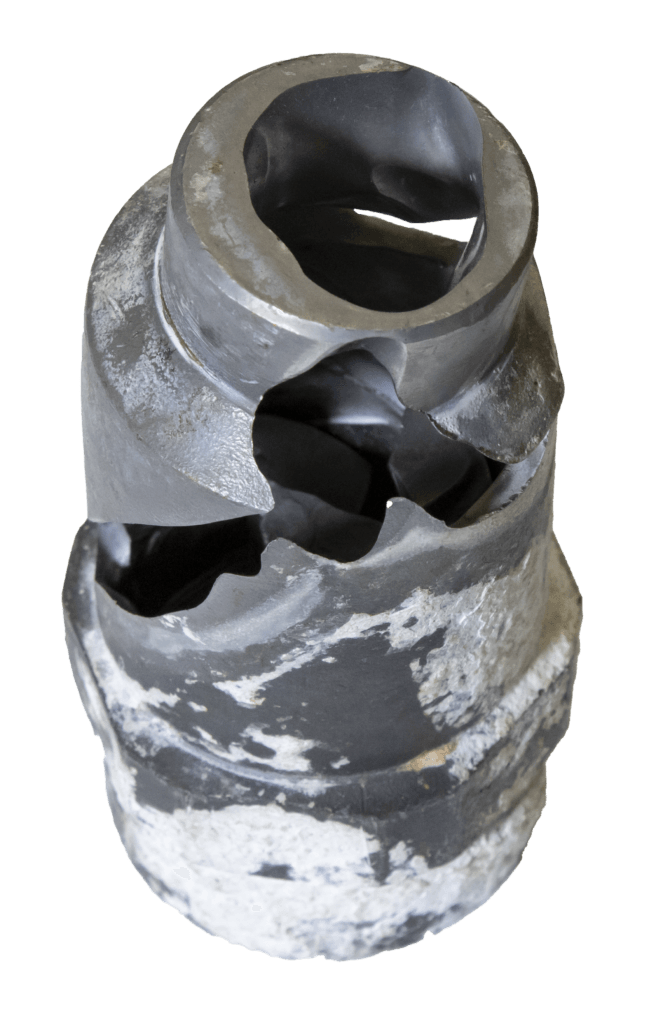
Temperature damage
CORROSION
Corrosion can lead to wear and tear, increased flow, changes in droplet size and spray pattern. This in turn leads to increased costs due to process deterioration, increased maintenance or equipment damage downstream in the process.
Corrosion is a common problem in many applications, especially when handling aggressive chemicals or in harsh environments. Nozzle materials differ in how well they resist corrosion. Plastics offer an economical solution for corrosion resistance, but are limited to low temperature applications. Metals offer a wide range of corrosion-resistant options, from cast iron to precious metals, stainless steel and nickel-based alloys, all of which provide superior protection.
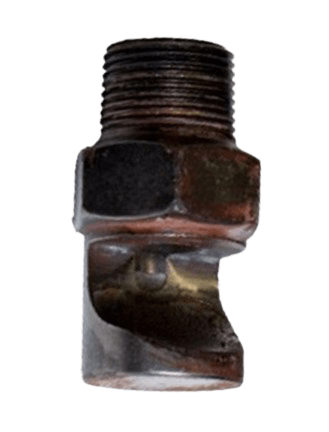
Corrosion damage
DURABILITY
Wear-resistant materials are essential to extend nozzle life in applications where the fluid contains abrasive particles. Here, hardened stainless steel, cobalt alloys, tungsten carbide or ceramics are preferred due to their durability against abrasive wear. These materials are often used in processes where liquids with abrasive properties are sprayed.
CHEMICALS
There are few general guidelines to this complex subject, but the material used for piping might provide a useful indicator of a suitable nozzle material. If you know which chemicals the process contains, we can assist you in finding a the right material for your process.
COST
Sometimes, of course, cost needs to be taken into account, but it is important to consider the cost of the investment over the full lifespan of the nozzle.
MATERIAL
Below is a list of the most requested spray nozzle materials. The list includes the standard specification (DIN), maximum temperature limit and BETE material code.
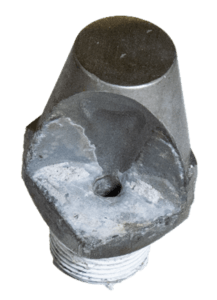
Abrasion damage
| Material Description | BETE Material No. | (DIN) Description | Temp. Rating (°C) | Trade Name |
|---|---|---|---|---|
| Brass | 4 | brass | 230° | |
| Naval Brass | 64 | 400° | ||
| Bronze | Bronze | 400° | ||
| L.C. Steel | 72 | carbon steel | 210° | |
| 303 | 5 | 1.4305 | 430° | |
| 304 | 6 | 1.4301 | 430° | |
| 304L | 1.4306 | 430° | ||
| 316 | 7 | 1.4401 | 430° | |
| 316L | 20 | 1.4404 | 430° | |
| 317 | 21 | 1.4440 | 430° | |
| 317L | 22 | 1.4438 | 430° | |
| 416 | 24 | 1.4005 | 430° | |
| Tungsten | 7H | |||
| Alumina | 26 | |||
| 904L | 74 | 1.4539 | 430° | |
| Alloy 20 | 70 | 2.4660 | 490° | Carpenter® 20 |
| Nickel Alloy M30C | 37 | 2.4360/2.4366 | 540° | Monel |
| Nickel Alloy 600 | 35 | 2.4816 | 1100° | Inconel® 600 |
| Nickel Alloy 625 | 3B | 2.4856 | 1100° | Inconel® 625 |
| Nickel Alloy 800 | 33 | 1.4876 | 1010° | Incoloy® 800 |
| Nickel Alloy 825 | 34 | 2.4858 | 1010° | Incoloy® 825 |
| Nickel Alloy B | 31 | 2.4800/2.4810 | 760° | Hastelloy® B |
| Nickel Alloy G | 32 | 2.4619 | 1100° | Hastelloy® G |
| Nickel Alloy G30 | 49 | 2.4603 | 1100° | Hastelloy® G30 |
| Nickel Alloy C276 | 81 | 2.4819 | 1100° | Hastelloy® C276 |
| Nickel Alloy C22 | 2A | 2.4602 | 1100° | Hastelloy® C22 |
| Nickel | 38 | Nickel | 350° | |
| Titanium | 11 | Titan | 540° | |
| tantalum | 40 | Tantalum | 1500° | |
| zirconium | 61 | zirconium | 540° | |
| Cobalt Alloy 6 | 9 | 1050° | Stellite® 6 | |
| SNBSC ceramic | 62 | 1660° | Refrax | |
| RBSC ceramic | 59 | 1380° | ||
| PTFE | 3 | PTFE | 150° | Teflon |
| PVDF | 36 | PVDF | 120° | Kynar ® |
| PVC | 1 | PVC | 60° | |
| CPVC | 16 | CPVC | 100° | |
| Polypropylene | 2 | Polypropylene | 70° | |
| UHMW | 17 | 80° | ||
| Polyurethane | 69 | 80° | ||
| ABS | 15 | 70° |
Related products

Full cone nozzles
The full cone nozzle is the most common type of spray nozzle in industry and distribute liquid over a circular area.
Show products
Hollow cone nozzles
The hollow cone nozzle is used when you want the volume flow to be concentrated on the outer part of the spray cone.
Show products
Flat fan nozzles
The flat fan nozzle is very efficient for various rinsing and washing processes. The droplets are relatively large compared to other nozzles and the spray has high impact.
Show products
Misting nozzles
Mist nozzles create a spray consisting of very small droplets even at low pressures. Used for humidification, cooling, surface treatment, etc.
Show products
Air atomising nozzles
Air atomising nozzles create a very fine spray of small droplets. Used for cooling, humidification, lubrication, surface treatment, etc.
Show products
Automatic nozzles
Spray nozzles with intermittent spray are used when you need high dosing precision and to avoid costly waste in the process.
Show products
Spray lances & spray systems
Spray nozzles for injecting liquid and gas into various process flows, as well as other customised solutions for specific requests and needs.
Show products
Spiral nozzles
Our range of different models of spiral nozzles. The spiral nozzle is available as full cone spray or hollow cone spray.
Show productsChoose the right spray nozzle for an optimised spray process
Each type of spray nozzle has a specific flow rate, spray pattern and droplet size. To optimise the spray process, it is important to understand how different parameters affect the choice of spray nozzle and solution.




A start-up meeting is important to find out about various factors that will affect choice of equipment and solution in order to achieve the most efficient and sustainable solution. We are happy to set up the start-up meeting as a web meeting or a site visit, depending on your preference. All details and information from the start-up meeting we will compilation which we then review with you to make sure we agree on the scope and objectives of the project.
Next step, we present a presents a proposal for a solutionwith a focus on function, service life, quality, choice of materials, operating and maintenance costs, and environmental impact. Our goal is to deliver a sustainable solution that creates added value for you as a customer.